
Panic, but no global spread of fallout from Japan 2011 nuclear disaster
Shortly after the 9.0-magnitude earthquake and resulting deadly tsunami struck Japan a year ago today – on March 11, 2011 – Japan’s Fukushima Daiichi Nuclear Power Plant began reporting problems. Ultimately, three of the reactors at Fukushima Daiichi overheated, causing meltdowns that eventually led to explosions, which released large amounts of radioactive material into the air. As people around the world watched and waited, some feared harmful radiation would spread to other parts of the globe. A hoax map, showing radiation spread to the U.S., scared many. Likewise, millions across Asia received a hoax email claiming to be part of “BBC Flash News.” It read:
Japan Government confirms radiation leak at Fukushima nuclear plants. Asian countries should take necessary precautions … Radioactive particles, which may cause burns, alopecia or even cancer, may be in the rain.
But it was not true. The BBC denied the attribution. Here in the U.S., in late March and early April 2011, scientists in western states did measure trace amounts of increased radiation from the disaster, but not enough to cause health problems.

Hoax map circulating in March 2011. It was completely false. Later, trace amounts of radiation were measured in U.S. western states, but not in great enough amounts to do harm.
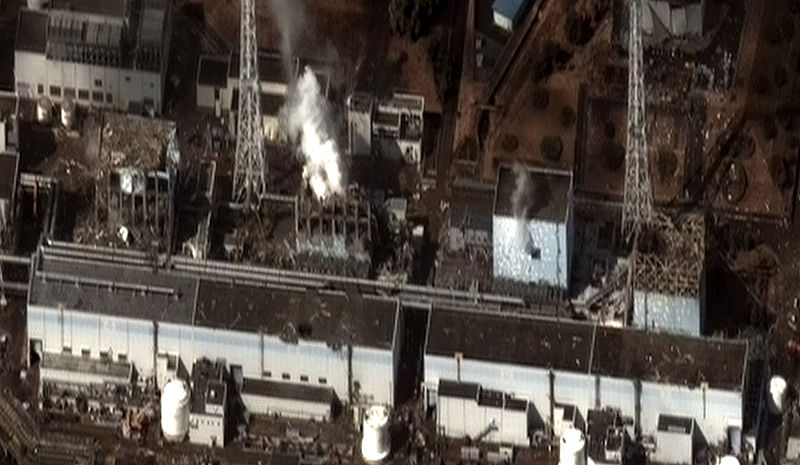
Three of the reactors at Fukushima Dai-ichi overheated, causing meltdowns that eventually led to explosions, which released large amounts of radioactive material into the air. Via Wikimedia
The radiation release in Japan was real and serious. Officials from the Japanese Nuclear and Industrial Safety Agency reported to CNN that radiation levels inside the plant itself were at one point up to 1,000 times normal levels. They told the New York Times that radiation levels immediately outside the plant were up to 8 times normal levels.
According to media reports, radioactive iodine was detected in the tap water in Fukushima, Tochigi, Gunma, Tokyo, Chiba, Saitama, and Niigata, and radioactive cesium in the tap water in Fukushima, Tochigi and Gunma. Radioactive cesium, iodine, and strontium were also detected in the soil in some places in Fukushima, and radioactive hotspots were found outside the evacuation zone. Today, one year after the disaster, there is still a 12-mile “no-go” zone around Fukushima, according to Discovery News.
In October 2011, the New York Times reported on an effort that had begun in Japan to track the long-term health effects of the Fukushima nuclear disaster. Japan authorities were surveying children for thyroid abnormalities, a problem associated with exposure to radiation. Presumably the full effects of the Fukushima disaster will take decades to unfold.
But the radiation from the Fukushima disaster did not spread around the globe, as many feared in the days following the earthquake and tsunami. The hoaxes were simply scare-mongering. In March 2011, climatologist Bill Patzert was widely quoted in the media as saying:
If we had multiple Chernobyl-type failures and it did go five to eight miles into the atmosphere and get into the jet stream, it could definitely impact the West Coast of the United States and Canada. But we’re not there yet.
Here in the U.S., in March and April 2011, traces of radiation were measured by teams of scientists in California and other western states. Researchers at the University of California at Berkeley reported that fallout from the damaged reactor extended as far as the San Francisco Bay Area, resulting in elevated levels of radioactive material that were nonetheless very low and posed no health risk to the public.

Scripps Pier in San Diego. Researchers here measured trace amounts of radiation from Fukushima. Image via Scripps Pier Weather
The Berkeley study came about a month after researchers in Southern California announced a similar finding, using an instrument at the end of a pier at the University of California at San Diego’s Scripps Institution of Oceanography.
Read about trace amounts of radiation found in San Francisco.
Read about trace amounts of radiation found in San Diego.
Other western U.S. states, including Nevada and Colorado, also reported some traces of radiation from the disaster.
By the way, is an excellent story in Daily Beast today, outlining some of the differences and lessons learned in the Fukushima nuclear disaster in contrast to the disaster at Chernobyl in Russia in 1986. You’ll find that story here.
Bottom line: After three reactors at Japan’s Fukushima Daiichi Nuclear Power Plant overheated and caused explosions in March 2011, following the 9.0-magnitude earthquake and tsunami there, scary stories of radiation spread circulated around the globe. But although trace amounts of radiation were measured in the U.S., they were not enough to cause health problems, according to scientists.
You Might Also Like Our Friends' Posts
Comments are closed for this story.


 Choosing from the best US Canadian and international sources, we gather and select weather stories from around the world. World Weather Post not only brings you breaking news about people affected by weather, but also provides insight on how weather is affected by people. You will also find a sense of humour and a curiosity for understanding the weather, climate change and the environment. World Weather Post, where everybody talks about the weather.