
Midwest Storm: Rain South, Snow North
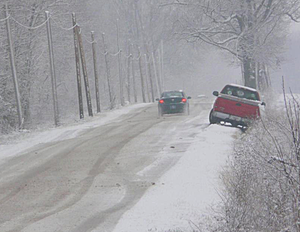
Enough general snow can fall over part of the central Great Lakes area to cause slide-offs. (Image from AccuWeather.com Facebook fan Michael G.)

By Alex Sosnowski, Expert Senior Meteorologist
Feb 15, 2012; 10:25 AM ET
A zone of slippery travel will expand from portions of Iowa and Minnesota today into part of the Great Lakes region tonight.
A light wintry mix is pushing eastward in the I-90 corridor of the Plains with a few slippery spots.
The storm will come together over the central Great Lakes tonight, producing a zone of moderate snow.
Areas favored to receive up to several inches of snow (10 cm) extends from the northern Lower Peninsula of Michigan and part of the Upper Peninsula to the Ottawa, Ontario, and Montreal, Quebec.

While the storm will bring mostly rain to Chicago and Detroit, snow will try to mix in tonight and could bring a light coating to some surfaces, especially in these city’s northern and western suburbs.

A wintry mix will push into London and Toronto, Ontario, during Thursday. This also means that the rain will be involved during part of the storm, which will impact accumulation, resulting in wet roads most of the time.
Speaking of wet roads, this will be a rain event for the Ohio Valley and as far north as South Bend and Fort Wayne, Ind., and Toledo and Cleveland, Ohio.
A few thunderstorms can join in along the Ohio River and are a sign that this storm will get its second wind moving northeastward during the day Thursday over the Northeast. It’s conceivable that downpours will slow travel for a time from St. Louis to Pittsburgh spanning Wednesday in the west and Thursday farther east.
According to Meteorologist Bill Deger, “Locally severe thunderstorms are anticipated farther south over the lower Mississippi Valley and northeastern Texas.”
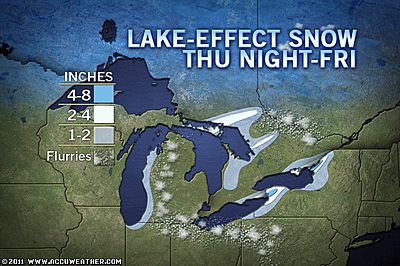
As far as lake-effect snow is concerned in the storm’s wake, a few places from the Upper Peninsula of Michigan to areas downwind of lakes Huron and Ontario could get more snow from lake effect than the actual storm itself.
Little or no lake effect is expected farther south of the lower part of Lake Michigan and Lake Erie.
While the lack of ice over the Great Lakes is a plus for late-season lake-effect snow, it may also quicken the arrival of warmer weather in the region this spring.
You Might Also Like Our Friends' Posts
Comments are closed for this story.




 Choosing from the best US Canadian and international sources, we gather and select weather stories from around the world. World Weather Post not only brings you breaking news about people affected by weather, but also provides insight on how weather is affected by people. You will also find a sense of humour and a curiosity for understanding the weather, climate change and the environment. World Weather Post, where everybody talks about the weather.