
Sindh (Pakistan) Flooding Follows Cloudbursts Last Week

Kotri, near Hyderabad Sindh Pakistan. Source: Wikipedia.
Sindh (Pakistan) Flooding Follows Cloudbursts Last Week
Aug 17, 2011; 1:33 PM ET
FLOODING IN SINDH PROVINCE DISPLACES THOUSANDS
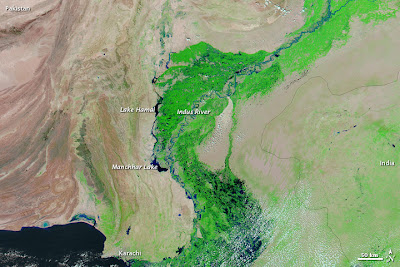
Another flooding tragedy in Pakistan, albeit no less than two orders of magnitude smaller in its population impact. This time, the province of Sindh is front and center following stunning outbursts of rain last week.
Following a mostly rainless July, then a bone-dry first week of August, the rain came in a big way to some, not all, of Sindh.
Turning to the Pakistan Meteorology Department (Pakmet), the daily rainfall table for August shows high to extremely high (10 cm or more) at six out of 16 sites. Nearly all of this is posted on daily tallies for Aug. 11 and 12.
Leading the way, rain-wise, Mithi had a staggering 436 mm (17 inches) of rain in three days (Aug. 10-12). Online mappers show Mithi tucked among sand hills in the southeast of Sindh. I believe normal August rainfall to be about 10 cm at Mithi, with normal yearly rainfall of about 30 cm.
Meanwhile, Badin had 295 mm within two days. Pakmet lists 92.5 mm for the average August rainfall here. Another source has normal yearly rainfall of about 21 cm. Badin is located on the heavily settled, intensely farmed Indus River Plain.
Other high amounts were at Mirpur Khas (245 mm in two days), Chorr and Hyderabad.
News reports from Pakistan tell of high flow and wall breaches on drains cutting the Indus Plain as runoff flows to the sea. Unfortunately, the low elevation of this flatland means that flood water is in no great hurry to get where it is going.
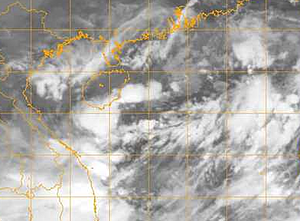
As I wrote earlier, I believe that these outbursts owed to a Monsoon low that may have originated as Typhoon Nock-Ten, which landed in northern Vietnam near the end of July.
KARACHI IS SPARED…
… from the flooding, anyways. That is the good news. At the same time, last week’s rain, amounting to 30 mm, was not enough to make up the shortfall of a rainless June and a deficient July, the city’s wettest month.
SO, WHY THE SHARP CONTRAST IN RAINFALL BETWEEN KARACHI AND SOUTHEAST SINDH?
So, why the sharp contrast in rainfall last week between Karachi and southeastern Sindh? I cannot answer this question. I can say that historical average summer rainfall in southern Sindh rises eastward. Also, the triggering mechanisms for extreme weather events of this kind can be subtle, if not small scale, and thus not knowable without an extensive, real-time observation network.
ANY MORE RAIN IN SIGHT FOR KARACHI?
I should have better insight as to whether Karachi has rain in its near future. In truth, I do not know with any meaningful confidence.
Having looked at two global forecast models, the results are “a coin toss,” as is sometimes said. One shows no widespread meaningful rain at Karachi; the other shows some potential for meaningful rainfall at the end of the week.
The latter scenario includes a Monsoon low that is forecast to strengthen as its spins west over Gujarat and southern Sindh to the northernmost Arabian Sea.
You Might Also Like Our Friends' Posts
Comments are closed for this story.



 Choosing from the best US Canadian and international sources, we gather and select weather stories from around the world. World Weather Post not only brings you breaking news about people affected by weather, but also provides insight on how weather is affected by people. You will also find a sense of humour and a curiosity for understanding the weather, climate change and the environment. World Weather Post, where everybody talks about the weather.