
Australia Autumn Coolest in over 60 Years
Australia Autumn Coolest in over 60 Years
Jun 1, 2011; 12:56 PM ET
Australia has had its coolest fall in at least 60 years, according to the nation’s weather service.
A statement issued by the Australian Bureau of Meteorology (BoM) has shown that the three fall months of March, April and May were cooler than average by 1.15 degrees C (2.1 degrees F). The average was determined from data for 1961-1990.
Previously, the coolest such season on record was that of March-May 1960, which registered 0.95 of a degree C (1.7 degrees F) below normal, according to the statement.
Government climatologists fingered La Nina as a key causative agent for the anomalous autumnal temperatures. Since 1950, four of the five coolest falls have happened during La Nina cooling. “La Nina” is the state of below-normal sea surface temperature over the central and eastern equatorial Pacific Ocean.
The report cited abnormally low daytime temperatures brought on by widespread rain-bearing clouds, the season’s high rainfall also being attributed to La Nina. Indeed, the BoM statement also showed autumn 2011 to have been fourth wettest on record, March alone having been wettest on record.
In pulling off the cool fall, Australia bucked the global trend, which saw the world’s seasonal average temperatures, combined land and sea, 0.4 of a degree C (0.7 of a degree F) above normal.
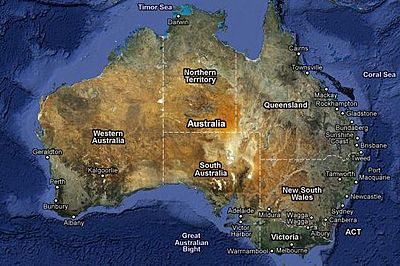
Google Maps image.
You Might Also Like Our Friends' Posts
Comments are closed for this story.


 Choosing from the best US Canadian and international sources, we gather and select weather stories from around the world. World Weather Post not only brings you breaking news about people affected by weather, but also provides insight on how weather is affected by people. You will also find a sense of humour and a curiosity for understanding the weather, climate change and the environment. World Weather Post, where everybody talks about the weather.